Put a neural network inside your C++ analytics and differentiate through both. For models up to about 1,000 inputs AADC trains and runs faster on CPU than TensorFlow, and it deploys without Python.
Python ML frameworks are slow in a production pricing path, and rewriting a trained model in C++ by hand is slow in a different way. AADC lets the model and the analytics around it be one compiled kernel.
ADBench benchmark results show AADC's significant advantage for quantitative finance applications
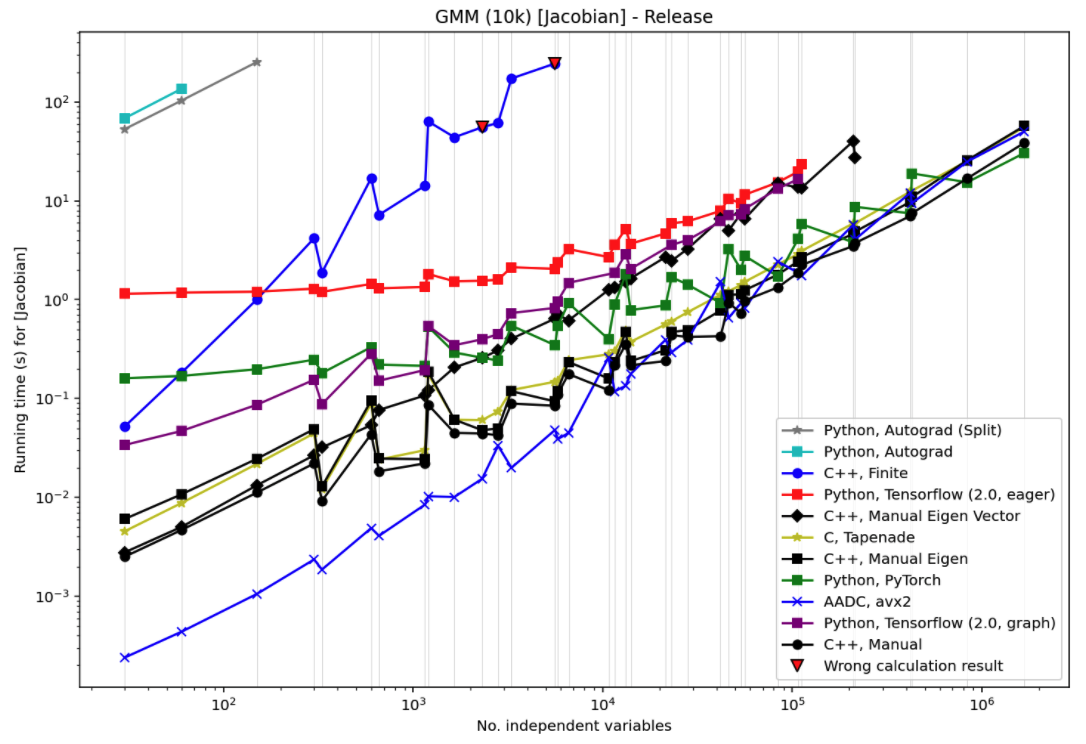
ADBench Performance Comparison: AADC vs TensorFlow vs PyTorch
Note: For very large models, in vision or language, performance is bound by memory bandwidth and the Python frameworks are the right tool. The quant range, hundreds to a thousand inputs, is where AADC is faster.
State-of-the-art neural network research from MatLogica and partners
Choose the approach that fits your development workflow
Build neural networks in C++ with AADC for pure ML workloads
Interleave a network with the business logic around it
Differential regression and differential PCA train on the pathwise differentials of the pricing function.
TensorFlow and PyTorch are designed for massive models (millions of parameters). Quantitative finance typically needs models with hundreds to thousands of.
Most ML frameworks optimise for GPUs. AADC is built for CPU performance, which is where production quant systems run. No GPU infrastructure needed.
No graph building overhead, no Python interpreter, no framework abstractions. Direct compilation to optimised machine code with automatic differentiation.
ML layers sit inside your existing C++ analytics. One language, no serialisation between the two, one binary to deploy.
For quantitative finance applications
| Feature | TensorFlow/PyTorch | AADC | Advantage |
|---|---|---|---|
| CPU Performance (up to 1K inputs) | Baseline | 10x+ faster | AADC |
| Training Speed | Baseline | Several times faster | AADC |
| Integration with C++ Analytics | Complex (language barriers) | Native C++ | AADC |
| Production Deployment | Python runtime required | Native C++ binary | AADC |
| GPU Requirement | Needed for good performance | CPU-only | AADC |
| Custom Layer Development | Framework-specific APIs | Standard C++ code | AADC |
| Very Large Models (>10K inputs) | Better | Good | TensorFlow/PyTorch |
| Pre-trained Model Ecosystem | Extensive | Limited | TensorFlow/PyTorch |
Note: AADC excels in the quantitative finance sweet spot (moderate model sizes, CPU deployment, integration with business logic), while TensorFlow/PyTorch are better for very large models and transfer learning scenarios.
See how AADC can deliver 10x+ performance improvements for your machine learning applications in quantitative finance.